
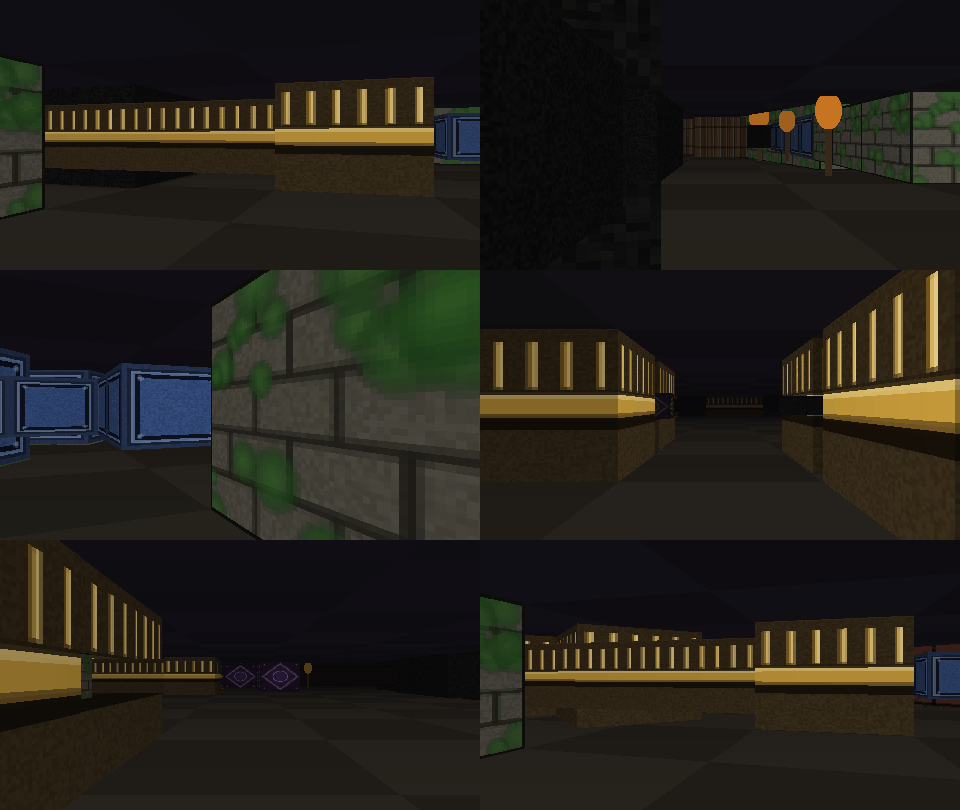
Doom Style Ray Cast Engine & Asset Pack
VOIDWALK — Raycast Engine Tech Demo A from-scratch Wolfenstein/Doom-style raycaster, built entirely in vanilla JavaScript on a single 2D canvas. No Three.js, no WebGL, no engine, no build step — open the HTML file and it runs. WHAT THIS IS This is a tech demo, not a game. There's no combat, no objectives, no enemies — just a fully walkable maze you can explore freely, built to show that a classic-style first-person renderer can still be built the old way: per-pixel raycasting against a 2D grid, rendered straight into a canvas ImageData buffer. Everything you see — every wall texture, every torch and pillar sprite, the floor, the ceiling — is generated procedurally at load time. There are zero image assets in this project. The whole engine is one HTML file. Open it in a browser, click to start, and you're walking. ENGINE BREAKDOWN Wall rendering uses the standard DDA (Digital Differential Analysis) algorithm — the same approach Wolfenstein 3D and id Tech 1 used. For every column of the screen, a ray is cast from the player through the camera plane, stepped one grid-cell boundary at a time, until it hits a wall. Distance is corrected to perpendicular (not Euclidean) to avoid fisheye distortion, and the wall's screen height is derived directly from that distance — closer walls fill more of the screen, exactly like a real 3D projection, but the underlying math never leaves 2D. Floor and ceiling use the companion technique, floorcasting: for each screen row below the horizon, the world-space distance for that row is computed, and the engine steps across X in world space sampling a checker pattern, properly occluded against whatever wall is nearer. Textures are not image files. Every wall texture is a 64x64 canvas, painted once at load time using direct draw calls — individually shaded bricks with bevel highlights, hand-tuned wood grain, a carved gold relief panel, a glowing arcane rune with real radial falloff. The raycaster samples these as raw pixel buffers during rendering, the same way it would sample a loaded image. Sprites (torches, orbs, pillars) are billboarded using a camera-space inverse transform, sorted back-to-front, and occlusion-tested per-column against the wall depth buffer so they correctly hide behind nearer walls. Asset pack export is built in: press X during the demo and it packages every texture, every sprite, the full map/player/sprite config as JSON, a formulas reference doc explaining the actual math, and a scripted GIF flythrough of the level — all zipped client-side, no server involved. CONTROLS WASD or arrow keys — move Mouse — look Shift — run M — toggle full map view F — toggle fog 1 / 2 — switch between textured and flat-shaded rendering X — export the full asset pack (textures, sprites, map data, formulas doc, GIF flythrough) WHY BUILD IT THIS WAY No WebGL context, no shader pipeline, no mesh data — just a flat array of pixels being written by hand, 60 times a second. It's a reminder that the genre-defining look of 90s first-person games came from clever math applied to a 2D buffer, not brute-force 3D hardware. If you've ever wanted to see exactly how that trick works under the hood, this is the whole thing, readable top to bottom in one file.
 GareBearProductionz 31 followers· portfolio 13 View creator →