Castefall Siege Of The Keep
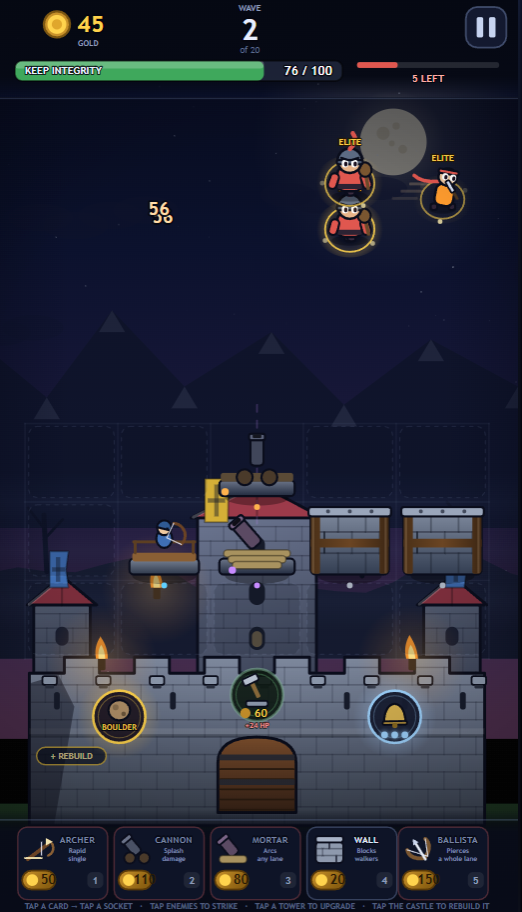
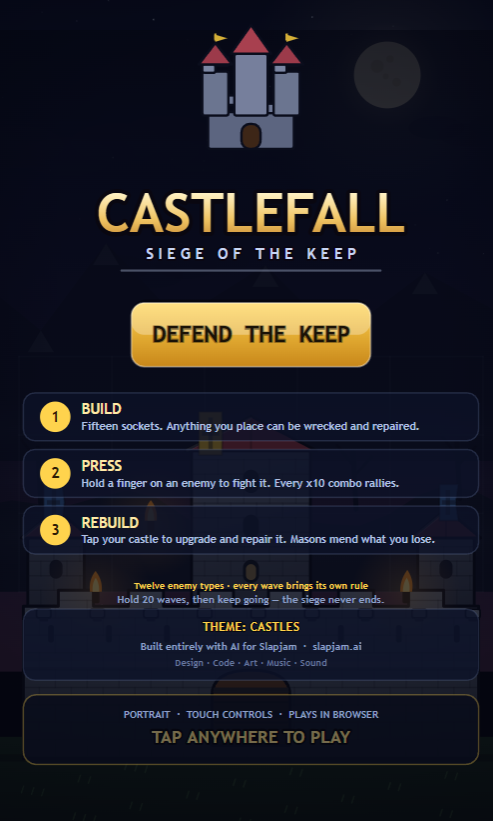
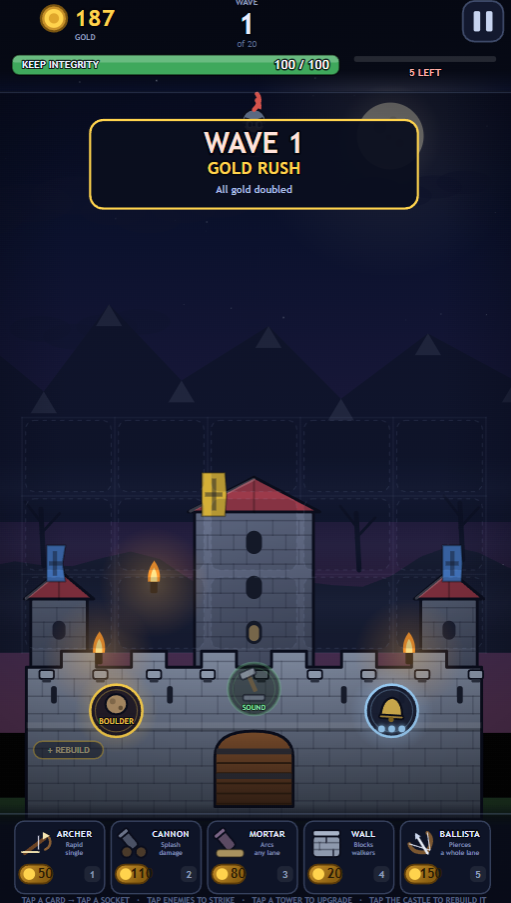
Castlefall — Siege of the Keep A portrait, touch-first castle defence game. You are the castellan of a keep at the bottom of the screen. Horde enemies march down five lanes toward your gate. You spend gold to raise defences on the wall above it, grow a garden behind it, rebuild the castle itself, and keep the gate shut — for 20 waves if you want the win, or forever if you don't. Play it in a browser. No download, no install, no account. How to play Everything happens with one thumb. There is nothing to learn before you start. TAP a card along the bottom, then TAP a socket on the wall to build. TAP a tower you already own to open its panel — upgrade, repair, or sell. PRESS AND HOLD on any enemy to keep striking it. A tether locks on and keeps hitting. Tap-repeating hits slightly harder, so tapping is a burst bonus on top of holding rather than a chore. TAP the great door in the middle of the wall to open the garden. Tap the stone either side of it to open Castle Works and upgrade the keep itself. (Or press C.) TAP the three medallions on the keep: the Alarm Bell stuns everything on screen, the Boulder drops on one lane, and the Repair Hammer buys back keep integrity when it is worth it. Keyboard, if you're on desktop: 1–5 pick cards, B or Space fires the boulder, C opens Castle Works, P pauses, Esc resumes, M mutes. Reach a combo of x10 by striking effectively and a Rally fires on its own, buffing every tower on the wall. How well you press is how you pace a wave, not just how much damage you do. The garden behind the gate Behind the great door is a garden: fifteen raised beds laid out in the same 3×5 grid as your wall, drawn in the same style. An empty bed looks like an empty socket, because that is the thing you are being asked to fill. The siege does not pause while you are in there. Enemies keep marching, towers keep firing, and you can keep planting while the gate is being hit. That is the whole reason to open it mid-fight — and it is a real risk, which is what turns spending a bed into a decision instead of a chore. Tap a bed to plant what grows there, or to level up whatever is already in it. One control, four states, always in the same place on every bed, so your thumb never has to hunt for it. Every planted bed pays you gold every wave and adds damage to the wall — a garden that only earned money would be a bank, not a defence, so your crops throw produce at whatever is furthest down the field. PlantSeed costGold per waveDamageRadish 110 +22 14 Bean Vine 170 +44 30 Tomato 240 +66 52 Sunflower 310 +98 78 Melon 400 +138 112 Beds level up to 12. You can watch it happen: a sprout at levels 1–2, full height at 3–6, and fruit from 7 on — tomatoes go green, then orange, then red; beans grow pods on a climbing frame; sunflowers open from bud to flower head. Past about level 9 the fruit count stops changing, so 9 through 12 look alike. That is deliberate. A long tail that stays honest is better than one you grind for screenshots. The garden is permanent progress. It survives KEEP DEFENDING with everything else. The wall never stops There is no level cap on your towers. Three curves move together, so upgrading is always the right call and never a dead end: Upgrade cost: base × 1.22^level — a gentle exponent that stays affordable forever Horde health: 2 × (1 + 0.30 per wave) × (1 + 0.62 × your average tower level) Kill bounty: base gold × (1 + 0.34 × your average tower level) Note what that third one is doing. It pays for roughly half of what your upgrades add to the horde's health. You are never coasting on your own investment. And it tracks the average level across the whole wall, not your best tower — so the pressure is to upgrade broadly rather than pour everything into one archer. Tap any tower and its panel spells out the trade in plain numbers. Five defences ARCHER — fast single-target down its own lane. Cheap, reliable backbone. CANNON — slow heavy splash. Shatters groups and chews through armour. MORTAR — arcs over the walls into any lane. The only reliable anti-air. WALL — blocks ground units. Climbers and Shriekers sail straight over it. BALLISTA — pierces a whole lane in a line. Fifty enemy types, and they attack your plan Every wave asks a different question. Some enemies phase out and cannot be hit at all. Some heal their escort. Some silence your firing towers. Some shell your walls from a range you cannot block. Some shoot your towers instead of the gate. Some siphon your gold and run. Some bury your walls outright. A few attack things that are not on the board at all — your sockets, your alarm bell, your corpse pile. A Warden boss shows up every fifth wave. Every tenth wave is a SIEGE RUSH — everything faster, half the gaps. Be warned: this one is hard on purpose. It was tuned until the horde outpaces a lazy wall, and the numbers above are why. Losing is normal. Learning which wave rule is quietly killing you is the actual game. Clearing wave 20 gives you the win — and the option to KEEP DEFENDING, which continues the exact run you were already in. Your towers, your gold, your keep, your Castle Works, your garden: all of it carries over, and the next wave is 21. Difficulty keeps climbing forever. Made for Slapjam Made with a lot of sweat using Space Bunny Free Max from OpenCode. Built with AI for Slapjam AI — a portrait, mobile-first browser game you can drop straight into a chat without installing anything. No engine, no framework, no build step, and no external assets whatsoever. Every sprite, every sound effect, and every note of music is generated at runtime from code. It runs straight off a single HTML page. A note on the theme Castles are the heart of it. The castle is the thing you build up, the thing you lose, and the thing the whole siege happens around. And somewhere behind it there is a garden that was there before the siege and will be there after, quietly growing while you fight.
JangYeongSil69420 View creator →Comments over time
Cumulative · 30dScreenshots
1 / 4