Manuscript Tycoon
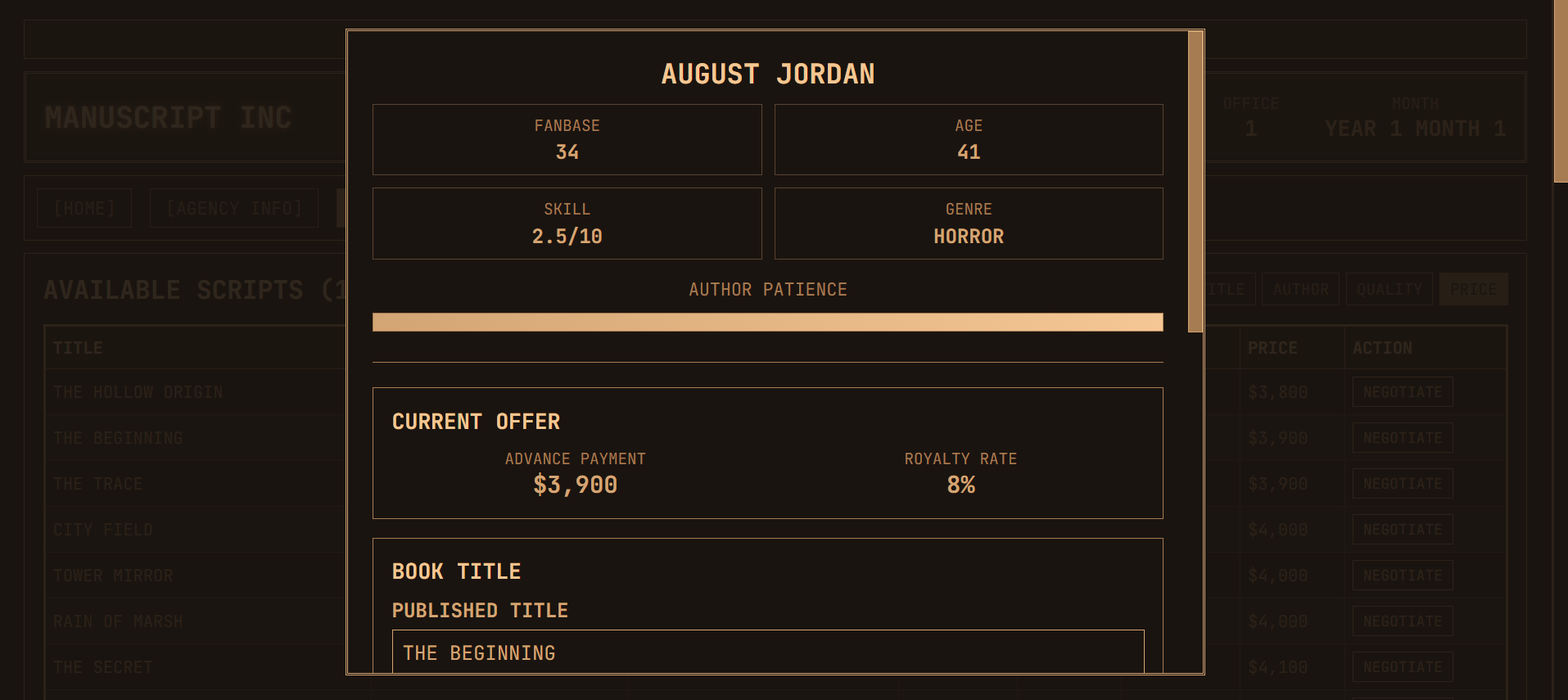
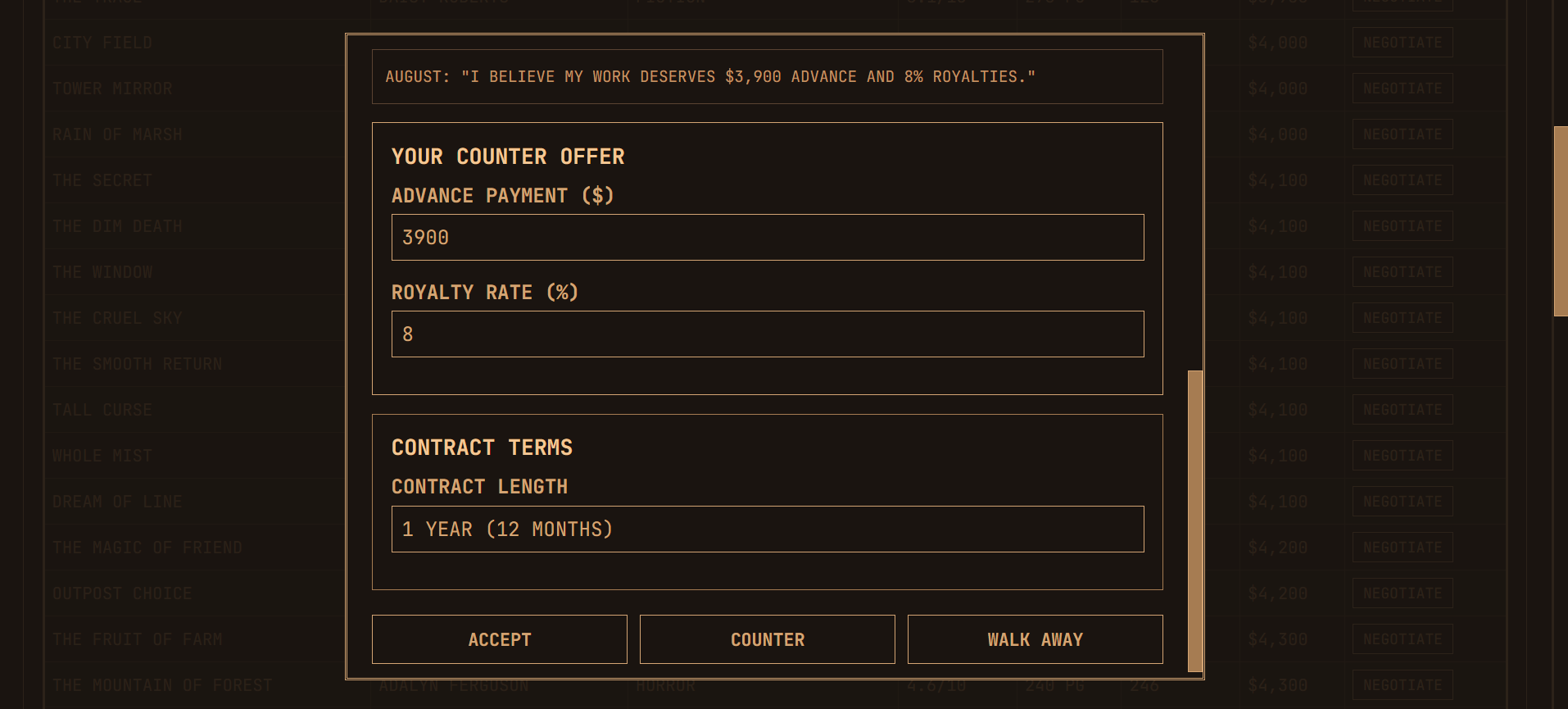
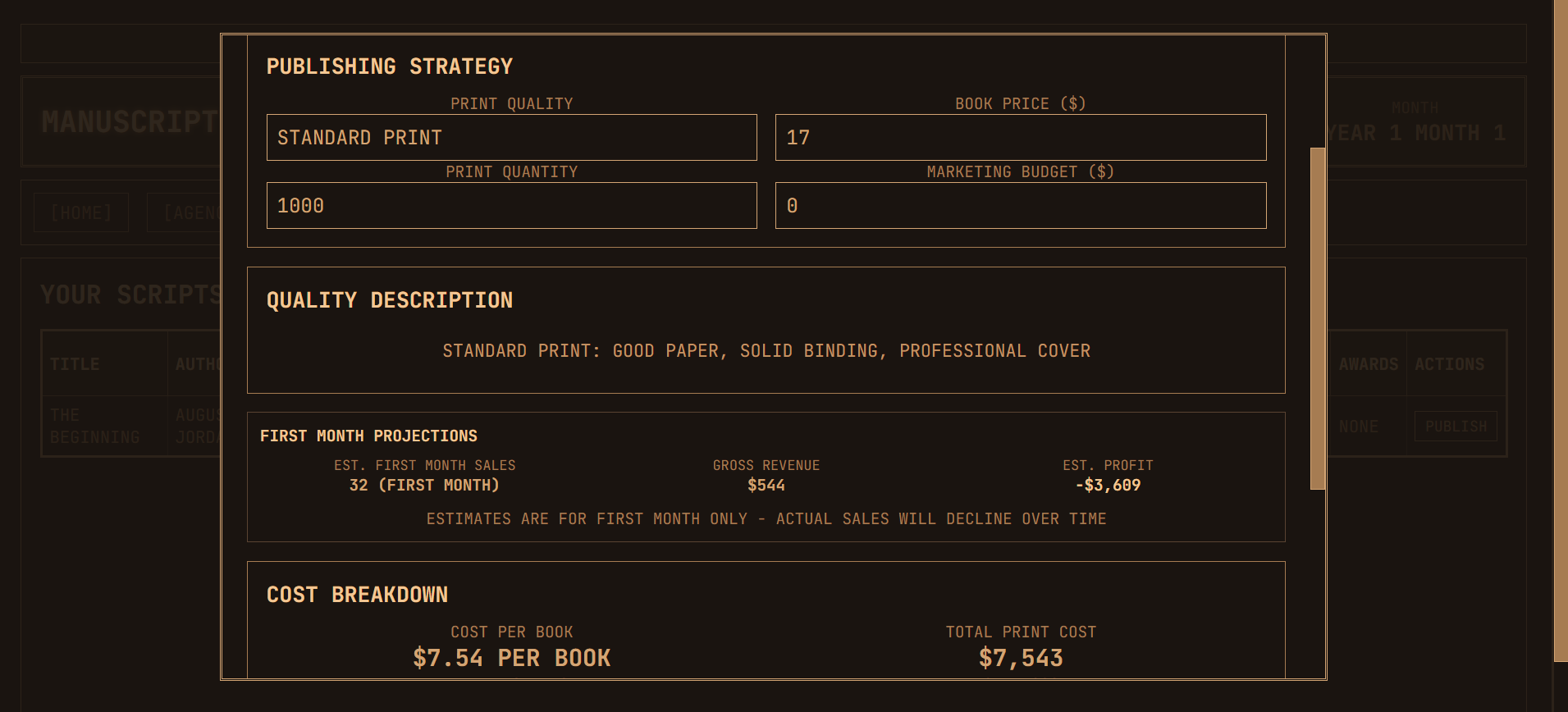
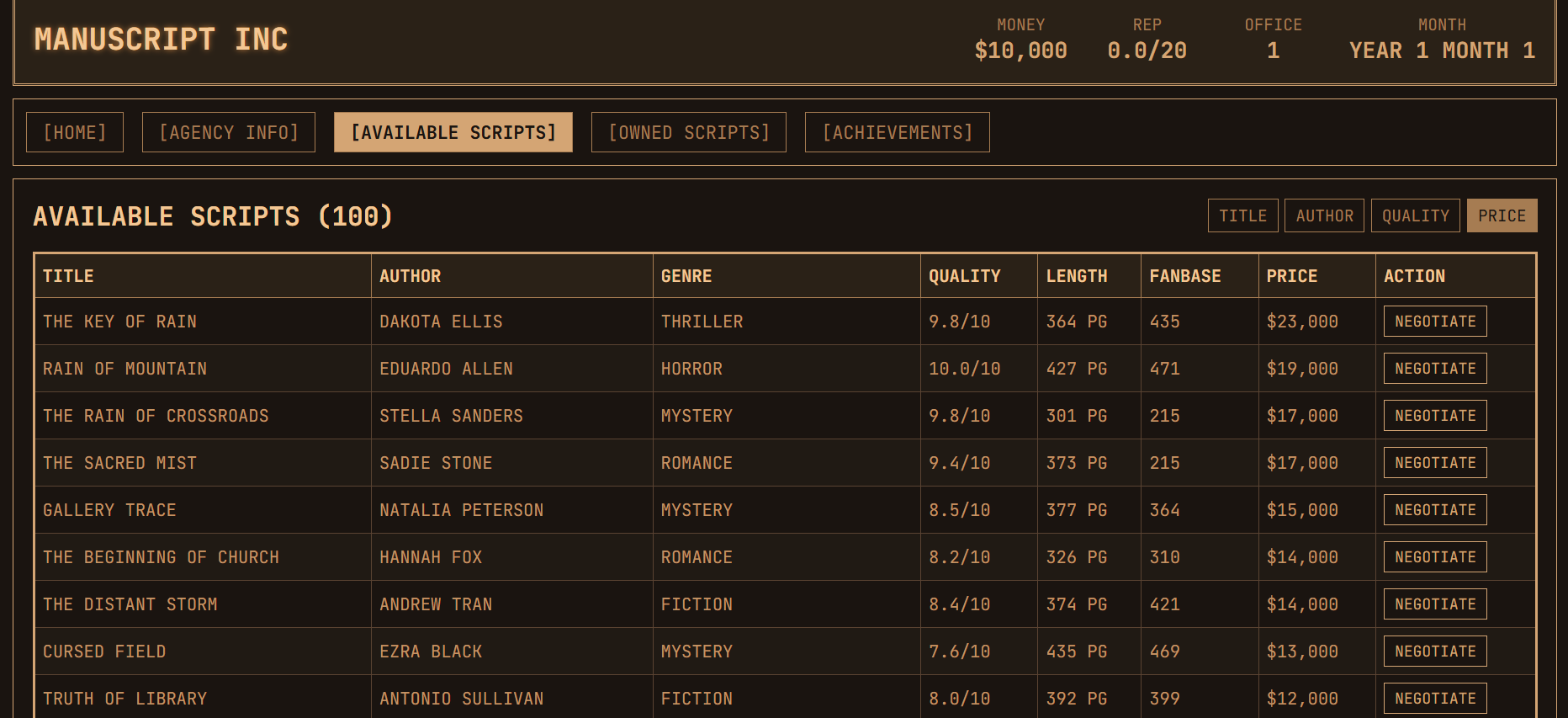
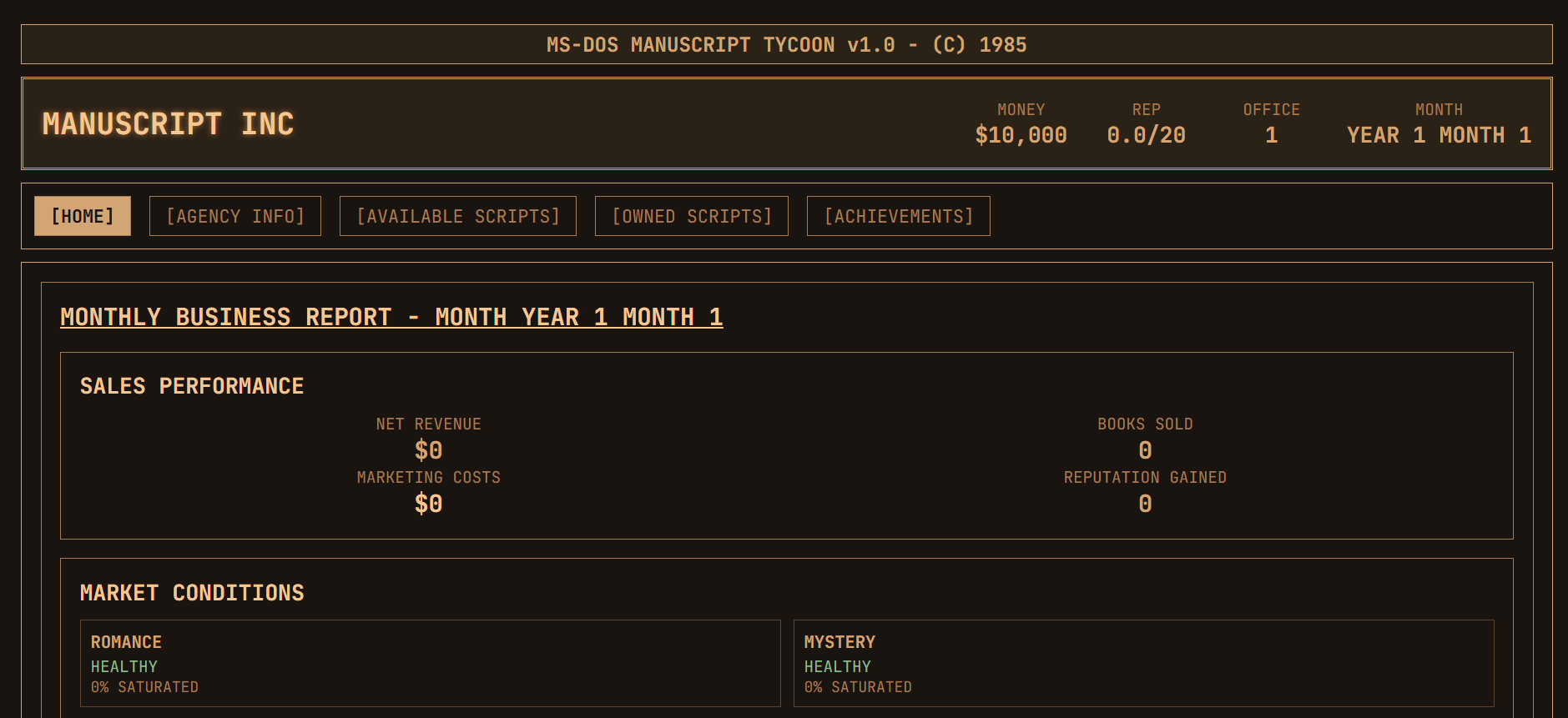
Build your publishing empire from the ground up in this retro business simulation! Start with $10,000 and a dream, then discover talented authors, negotiate book contracts, and make crucial publishing decisions that will determine your success. GETTING STARTED UNDERSTANDING THE INTERFACE Main Tabs HOME: Monthly reports, market conditions, and time advancement AGENCY INFO: Company statistics and office management AVAILABLE SCRIPTS: Browse and negotiate with new authors OWNED SCRIPTS: Manage your published and unpublished books ACHIEVEMENTS: Track your progress and unlock rewards Key Statistics Money: Your available cash for advances, printing, and marketing Reputation: Industry standing that affects author quality and office upgrades Office Level: Determines warehouse capacity and maximum reputation FINDING AND SIGNING AUTHORS Author Evaluation When browsing available scripts, consider these factors: Manuscript Quality Quality Rating: 1-10 scale, directly impacts sales potential Length: Affects printing costs and pricing options Genre: Market conditions vary by genre Max Sales Potential: Total lifetime sales estimate Author fanbase: Existing readers (higher = better initial sales) Negotiation Strategy Understanding Market Value Each author has a "fair market value" for their advance and royalty rate: High-quality books (8.0+): Worth premium advances and royalties Mid-tier books (5.0-7.9): Standard market rates Low-quality books (<5.0): Minimal investment recommended Negotiation Tips Start Conservative: Offer slightly below asking price to test patience Watch Patience Bar: Don't push too hard or authors will walk away Quality Investment: High-quality authors justify higher payments Contract Length: Choose based on book potential: 6 months: Quick turnaround for uncertain projects 12 months: Standard contract length 24-36 months: Lock in great books longer PUBLISHING STRATEGY Print Quality Options BUDGET PRINT (60% of standard cost) Best For: Low-quality books, oversaturated markets, price-sensitive genres Pros: Lower printing costs, competitive in saturated markets Cons: -15% sales appeal, hurts reputation if used on high-quality books Genres: Works okay for Romance, Young Adult, Horror STANDARD PRINT (100% of standard cost) Best For: Most books, safe middle-ground choice Pros: No penalties, balanced cost-to-benefit ratio Cons: No special bonuses Genres: Good for all genres PREMIUM PRINT (180% of standard cost) Best For: High-quality Literary Fiction, Historical Fiction, collector genres Pros: +25% sales appeal when justified, reputation bonus, holiday gift bonus Cons: Much higher costs, penalties for inappropriate use WARNING: Only use on 8.0+ quality books in suitable genres! Pricing Strategy Price Optimization The game calculates optimal pricing based on: Book quality: Higher quality justifies higher prices Genre: Some genres are more price-sensitive than others Print quality: Premium printing allows higher prices Genre Price Sensitivity Most Sensitive: Romance, Young Adult (price carefully) Moderately Sensitive: Mystery, Thriller, Horror, Sci-Fi, Fantasy Least Sensitive: Literary Fiction, Historical Fiction (readers pay for quality) Pricing Guidelines Underpricing: Can increase sales but hurts reputation and revenue Optimal Pricing: Follow the game's recommendations Overpricing: May limit sales, especially in price-sensitive genres Marketing Investment Marketing Effectiveness Tiers Books are classified as SMALL, MID-TIER, MAJOR, or BLOCKBUSTER based on sales potential: Small Books (under 15K potential): Need $200-$5,000 for effect Mid-Tier Books (15K-50K potential): Need $500-$12,000 for effect Major Books (50K-100K potential): Need $1,000-$30,000 for effect Blockbuster Books (100K+ potential): Need $2,000-$60,000 for effect Launch vs. Monthly Marketing Launch Marketing: One-time investment for publication month Monthly Marketing: Ongoing investment that continues until changed Synergy Bonus: Books with both launch and monthly marketing perform better Marketing ROI No Marketing: Books will significantly underperform Appropriate Marketing: Can increase sales by 200-400% Over-Marketing: Diminishing returns after 4x multiplier MANAGING YOUR BOOKS After Publication Inventory Management Monitor Stock: Keep track of copies in inventory Reprint Timing: Order reprints before running out of popular books Warehouse Limits: Upgrade office to increase storage capacity Contract Expiration Warning System: Game warns when contracts have 2 months remaining Automatic Expiry: Books are removed when contracts end Remaining Inventory: Unsold copies are destroyed at expiry MONTHLY OPERATIONS Monthly Cycle Sales Calculation: Each published book sells based on quality, marketing, and market conditions Cost Deduction: Rent, overhead, marketing, and operating costs are deducted Market Updates: Genre saturation changes, random market events may occur Awards: Books may win awards that boost sales Contract Updates: Expiring contracts are processed Operating Costs As you grow, monthly costs increase: Fixed Costs Office Rent: Based on office level Monthly Overhead: $300 per office level Variable Costs (scale with business size) Staff Costs: Based on number of active books Storage Costs: Based on inventory levels Author Relations: Based on number of unique authors Technology Costs: Based on books published Reputation Maintenance: Higher reputation costs more to maintain Market Conditions Saturation: Genres become oversaturated when too many books are published Recovery: Markets slowly recover each month Random Events: Major publishers or bestselling authors can affect markets GROWTH AND EXPANSION Office Upgrades Level 1 → 2 ($10,000) Warehouse: 1,000 → 5,000 copies Max Reputation: 20 → 40 Monthly Rent: $200 → $400 Level 2 → 3 ($20,000) Warehouse: 5,000 → 10,000 copies Max Reputation: 40 → 60 Monthly Rent: $400 → $800 Level 3 → 4 ($40,000) Warehouse: 10,000 → 100,000 copies Max Reputation: 60 → 80 Monthly Rent: $800 → $1,600 Level 4 → 5 ($80,000) Warehouse: 100,000 → 500,000 copies Max Reputation: 80 → 100 Monthly Rent: $1,600 → $3,200 Reputation Building Publishing Strategy: Premium printing on quality books helps Sales Success: Monthly revenue over $8,000 provides reputation Award Winners: Books that win awards boost reputation Business Scale Start Small: Focus on 1-3 quality books initially Gradual Growth: Add new titles as cash flow improves Infrastructure: Upgrade office before hitting warehouse limits Diversification: Publish across multiple genres for stability TIPS FOR SUCCESS Early Game (Months 1-12) Start Conservative: Sign 1-2 mid-quality authors initially Learn Negotiation: Practice on lower-stakes deals Moderate Marketing: Invest less than 2,000 in marketing per book Mid Game (Year 2-3) Quality Focus: Target 7.0+ quality authors Strategic Marketing: Match marketing levels to book potential Diversify Genres: Publish across 3-4 different genres Office Upgrades: Reach Level 3-4 office for better capacity Award Hunting: Publish premium Literary Fiction for prestige Late Game (Year 3+) Market Leadership: Build 50+ reputation for top-tier authors Efficient Operations: Optimize marketing and printing strategies Portfolio Balance: Maintain 8-12 active titles simultaneously
 esiotek 4 games· 71 followers· 31 ratings· portfolio 57 View creator →
Ratings over time
Cumulative · 30dComments over time
Cumulative · 30dScreenshots
1 / 6